By Magdy Fattouh — Egypt Tours By Locals | Last Updated: March 2026
I have a complicated relationship with Khan el-Khalili.
I love it. I have been coming here since I was a child — with my father, who used to buy spices here every Friday morning, and later on my own when I started learning Cairo on foot. I know alleyways within this Bazaar that most tourists have never walked down and that a significant number of guides do not know exist.
The goldsmith who has been in the same corner of the gold souk for thirty years, the spice merchant whose cardamom is the best I have found anywhere in Egypt, the copper workshop down a side alley where a craftsman named Ahmed is still engraving trays the same way his father taught him — I know these people, and they are the reason the market is worth your time.
I also know the tourist trap version of Khan el-Khalili — the first 200 metres from where the tour buses park, where almost everything you see is made in China, priced for people who do not know better, and sold by vendors who have had decades of practice at separating visitors from their money before they understand what they are looking at.
Both of these things are simultaneously true. And the experience you have at Khan el-Khalili depends almost entirely on which version you encounter. What follows is the honest guide — the good, the complicated, and the extraordinary.
Khan el-Khalili in 60 Seconds
| Founded | 1382 AD by the Mamluk emir Djaharks el-Khalili as a caravanserai |
|---|---|
| Location | Heart of Islamic Cairo, adjacent to Al-Azhar Mosque and Al-Hussein Square |
| Size | Dozens of interconnected alleys, covered souks, and open squares |
| Character | Part tourist market, part authentic souk, part living medieval neighbourhood |
| Best time | 10am–noon for quieter shopping; 8–10pm for atmosphere and culture |
| Best day | Any day except Friday morning; Ramadan evenings are extraordinary |
The Honest Map: What’s Where
Khan el-Khalili is not one market. It is a collection of specialised souks, and knowing which alley sells what changes the experience entirely. Most tourists see only the surface layer.
| Area | What’s Here | Tourist or Local? | Our Assessment |
| Main tourist alley (entry from Al-Hussein Square) | General souvenirs, papyrus, scarabs, tourist trinkets | Tourist-facing | Manage expectations — prices high, quality variable |
| Gold souk (Goldsmiths’ Quarter) | Gold and silver jewellery, sold by weight | Mixed tourist & local | Excellent — transparent weight-based pricing |
| Spice market (Souq al-Attarine) | Genuine spices, herbs, karkade, essential oils | Local-facing | Outstanding quality, fraction of tourist prices |
| Copper and brass workshops | Handmade engraved trays, lamps, decorative items | Mostly local trade | Best quality souvenirs in the market |
| Perfume alley | Essential oils, blended perfumes, attar | Tourist-facing but authentic | Good if you identify genuine oil shops |
| Textile section | Fabrics, kaftans, Bedouin-style scarves | Mixed | Variable quality — know what you want before entering |
| Al-Muizz Street extension | Antiques, Islamic art objects, high-end crafts | Serious buyers, some tourists | High quality, higher prices — negotiate |
| Abd el-Zaher Bookshop | Handmade leather notebooks, custom Arabic stamps | Almost entirely local | Hidden gem — personalised souvenirs, 80+ years operating |
What to Buy: Our Honest Recommendations
Buy: Gold Jewellery from the Gold Souk
The gold souk — the Goldsmiths’ Quarter, a concentrated network of jewellers inside and adjacent to Khan el-Khalili — is one of the most honest purchasing environments in the entire market. Gold is sold by weight at the daily Bazaar rate, which you can verify instantly on your phone. The making charge (the craftsman’s fee) is where negotiation happens, and it is entirely reasonable at the better shops.
The signature Cairo souvenir is the cartouche — your name or a chosen word rendered in hieroglyphics in a gold or silver oval pendant, engraved on the spot while you wait. A good cartouche from a reputable jeweller takes 30–60 minutes to complete and is a piece of genuinely skilled work. Silver cartouches start at approximately 800–1,500 EGP depending on size; gold is priced on the daily market rate plus making charge.
How to identify a trustworthy jeweller: look for 18k or 21k hallmarks stamped on all gold pieces, 925 marks on silver. A jeweller who weighs the piece in front of you on a scale and shows you the current gold price per gram is operating honestly. Any jeweller who resists weighing, or quotes a price before you have looked at the weight, is one to leave.
Practical tip: Look for longer-established shops deeper in the Goldsmiths’ Quarter rather than the first glittering facades at the tourist corridor entrance. Families who have operated for 30–40 years take their reputation seriously. Ask the vendor how long they have been in the souk.
Combine your bazaar visit with a full city experience—Explore Cairo in a Day and discover Cairo like a local.
Buy: Spices from Souq al-Attarine
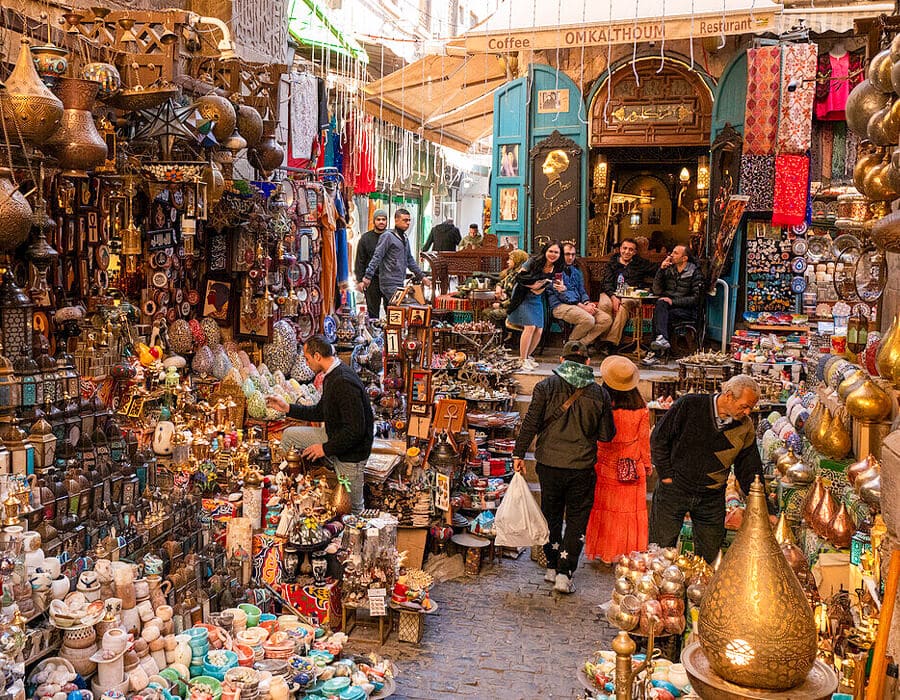
Walk past the tourist souvenir stalls, through the main alley, and into the spice market behind them. The transition is immediate: professional merchants selling to wholesale buyers and regular Cairene customers, bulk quantities on open display, no performance for tourists.
Priority purchases: karkade (dried hibiscus flowers — genuine Egyptian karkade has a depth of colour and flavour unlike anything available in Western supermarkets), black seed (nigella/habbatus sauda), cumin and coriander of exceptional freshness, and a custom spice blend assembled to your specifications. Budget 80–150 EGP for 200g of a custom ras el-hanout or baharat blend.
Practical tip: Ask the merchant to vacuum-seal your spice purchases. Most will do this without being asked. It preserves freshness and prevents the aroma from spreading to everything else in your luggage.

Buy: Handmade Copper from Working Workshops
Follow the sound of hammering down the side alleys and you will find workshops where artisans are engraving, shaping, and finishing pieces in front of you — not assembling imported blanks, but making objects from raw metal. A hand-engraved copper tray of medium size (30–40cm) takes several hours of skilled work and tells you something true about the city.
Price guide: a medium engraved tray costs approximately 300–600 EGP from a workshop; the same or inferior product starts at 800 EGP in the tourist alley. The discrepancy tells you everything.
Make your solo trip more enjoyable by reading Traveling Alone in Egypt before exploring Cairo’s famous markets.
Buy: Abd el-Zaher Bookshop (The Hidden Gem)
Just off a side street behind Al-Azhar Mosque, adjacent to Khan el-Khalili, is Abd el-Zaher — a bookshop and bindery that has been making handmade leather-bound notebooks, stamping names in Arabic or English into custom covers, and rebinding old books for over 80 years. Three generations of the same family work here. A personalized leather notebook with your name stamped on the cover costs approximately 100–250 EGP and takes about 20 minutes. This is one of the most personal and genuinely Egyptian souvenirs available anywhere in Cairo, and almost no tourist knows it exists.
Buy: Genuine Perfume Oils
Egypt has one of the world’s great essential oil traditions — jasmine from the Nile Delta, rose, oud, frankincense, and kyphi (a reconstruction of an ancient temple incense blend). The perfume shops of Khan el-Khalili are legitimate destinations if you know how to navigate them. Genuine Egyptian essential oil is thick, concentrated, and does not evaporate quickly when applied to skin. A 10ml bottle of quality single-note oil: 150–400 EGP. A 30ml custom blend: 400–900 EGP. Spend time smelling rather than buying immediately; a good vendor will encourage this.
Plan smarter and travel better with our Essential Egypt Travel Tips when visiting iconic spots like Khan el-Khalili.
What Not to Buy
Most ‘Papyrus’
The vast majority of what is sold as papyrus in the tourist areas of Khan el-Khalili is banana leaf or a cellulose substitute. It is not papyrus. The artwork on it can be beautiful and the price is fair as a decorative souvenir — but if you want genuine papyrus, you need to know how to identify it.
How to test: hold the piece to a light source. Genuine papyrus shows a fine, almost fabric-like woven structure. Banana leaf shows thick parallel fibres. Genuine papyrus is also slightly flexible; banana leaf is more brittle. Established reputable papyrus shops that show you the difference are found away from the main tourist alleys.
‘Antiques’ from Market Stalls
The overwhelming majority of ‘antiques’ in tourist Bazaar stalls are reproductions — made recently in factories, artificially aged, and sold with stories about their origins. Genuine Egyptian antiquities cannot legally be sold or exported without government authorisation. Legitimate antiques dealers are licensed establishments with official documentation, not Bazaar stalls. If a stall vendor shows you a ‘Pharaonic scarab from a private collection,’ it is a reproduction.
For easy access to Khan el-Khalili and beyond, check out Where to Stay in Cairo? before booking your trip.
Mass-Produced Souvenirs from the Tourist Alley
The plastic pyramids, machine-printed scarves, and Chinese-made Pharaonic figurines filling the first 200 metres of the market are available cheaper in their actual country of manufacture. They are not wrong to buy — a magnet for the fridge is a magnet for the fridge — but they have nothing to do with Egypt beyond the imagery. Walk deeper into the market before spending anything.
The Experience Beyond Shopping
El-Fishawy Café
El-Fishawy opened in 1797 — one year before Napoleon’s invasion of Egypt. As of 2026, it has been serving tea, coffee, and shisha continuously for 229 years. The café has been run by successive generations of the same Fishawy family for seven generations. It is open 24 hours a day, seven days a week, without exception.
The interior is extraordinary: handmade arabesque furniture, mashrabiya wooden screens, gilded mirrors installed specifically so the original owner could monitor the surrounding alleys, copper chandeliers, and the dense, layered smell of apple tobacco shisha and mint tea. At the counter, tea is brewed in the traditional Egyptian method — slowly, in brass pots, over heated sand.
Naguib Mahfouz — Egypt’s Nobel Prize-winning novelist — composed parts of his Cairo Trilogy in this café, in a back room that still carries his name. Nobel laureate Ahmed Zewail was a regular visitor. King Farouk, Egypt’s last monarch, held a dedicated seat here during Ramadan.
What to order: mint tea (na’na), karkade (hibiscus tea served cold or hot), or ahwa sada (unsweetened Arabic coffee). The shisha — apple tobacco, standard — is the full El-Fishawy experience. Prices remain genuinely affordable: tea at 20–40 EGP.
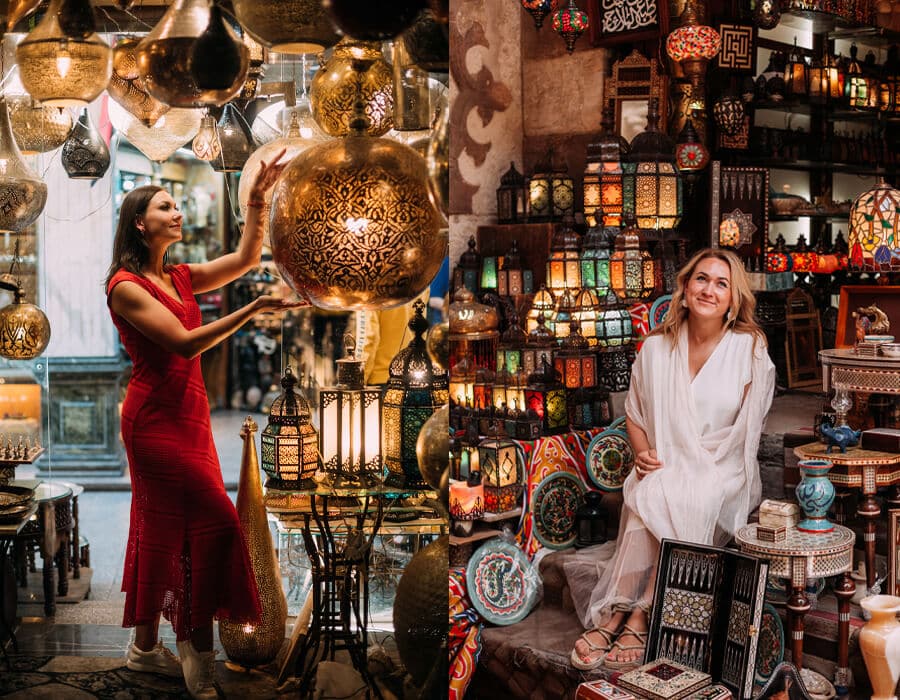
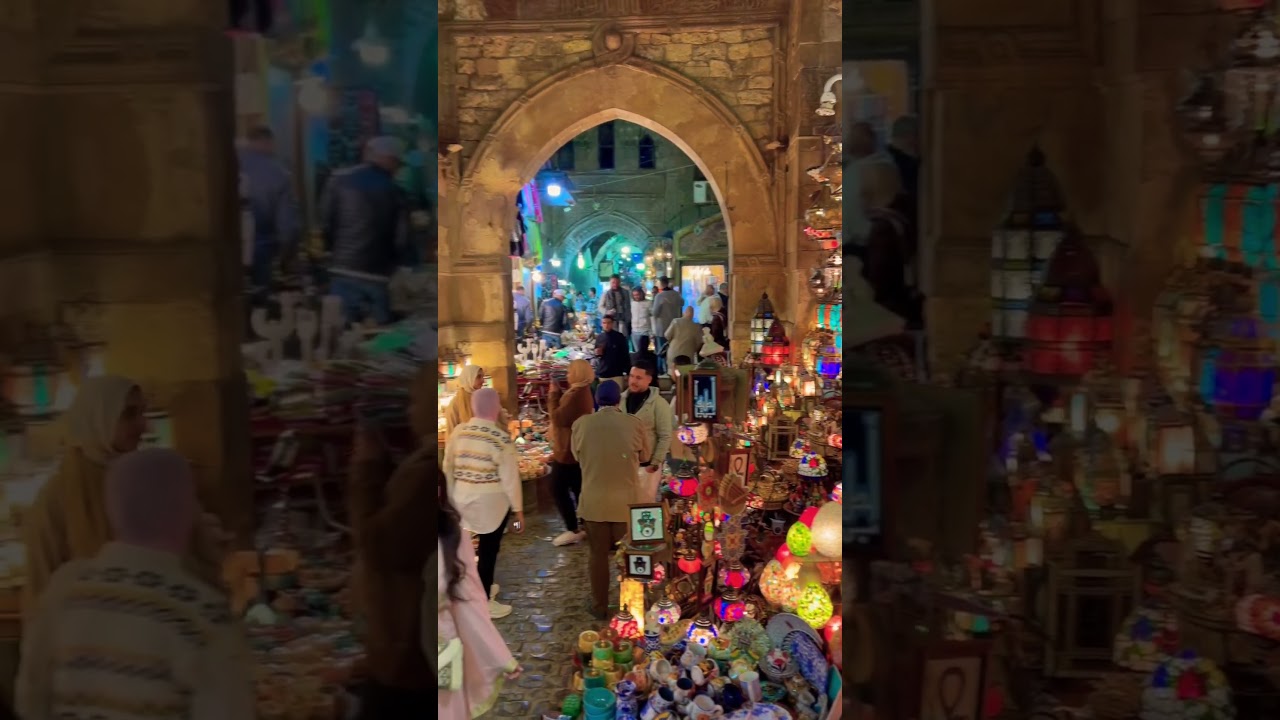
The best time to be here is after sunset. The alley quiets slightly, the lanterns glow, the café fills with a mix of families, students, tourists, and older Cairenes who have been coming since childhood. Sit for an hour. Do not rush.
Vendor note: people operating in the surrounding alley will approach you while you sit. A quiet ‘la’, shukran’ (no, thank you) without extended eye contact is effective. Do not let them spoil something genuinely worth experiencing.
To enjoy the bazaar at its best, explore the Best Time to Visit Egypt and choose the perfect season for your trip.
The Walk Nobody Takes: Al-Muizz Street After Dark
Most tourists enter from Al-Hussein Square and stay within the main tourist corridor. The experience that separates an ordinary visit from an extraordinary one is the Al-Muizz Street walk — begun from the Khan el-Khalili end, moving north along the world’s most intact medieval Islamic street, in the hour after Maghrib prayer (sunset) when the light is golden and the traffic has thinned.
Al-Muizz Street has been a commercial and religious artery of Cairo since the 10th century. It is 1 kilometre long and flanked on both sides by intact medieval Islamic architecture: mosques, madrasas, sabils, palaces, and covered markets. It was restored in the early 2000s and closed to vehicle traffic. In the evening, lit from beneath, with the call to prayer echoing from the minarets above, it is one of the most beautiful walks in Africa.
The walk starts at the Madrasa and Mausoleum of Sultan Barquq (just north of Khan el-Khalili), moves north past the Sabil-Kuttab of Abd al-Rahman Katkhuda and the Al-Hakim Mosque, and ends at Bab al-Futuh — one of the original medieval city gates. Return south and stop at a juice stall for fresh sugarcane juice (aseer asab) pressed in front of you. The walk takes 45–90 minutes at a relaxed pace.
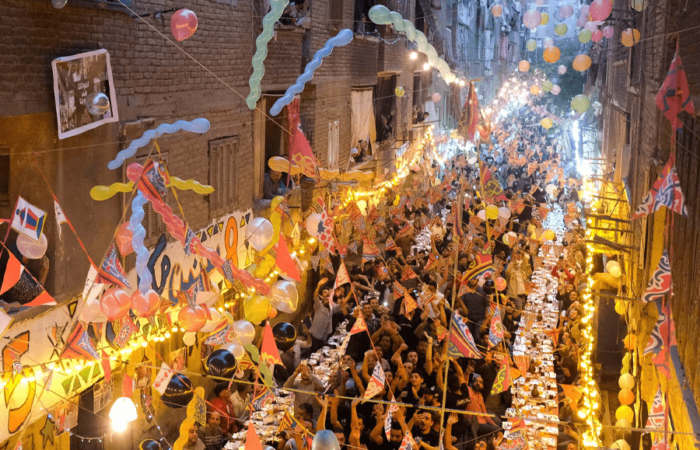
During Ramadan: Khan el-Khalili and Al-Muizz Street at night during Ramadan achieve something close to mythological — the fanous lanterns hanging between medieval buildings, the Iftar tables set up in the squares, families and visitors mixed together in the evening warmth. The last ten nights of Ramadan in this quarter are among the most extraordinary experiences available anywhere in Cairo.
Getting Deep into the Market: Our Recommended Route
The following is the route we use on private tours — the one that reaches the real Khan el-Khalili rather than the tourist surface.
- Enter from: Al-Hussein Square, facing the Al-Hussein Mosque.
- First: walk straight past the tourist stalls on the main alley without stopping. They will be there when you leave. Continue until you reach the spice Bazaar — the transition from tourist goods to professional spice trading is visible and immediate.
- Second: spend time in the spice market. Let the merchant explain what you are smelling. Buy here, not from the tourist stalls at the entrance.
- Third: follow the sound of hammering into the copper workshop district — the side alleys to the west of the main tourist corridor.
- Fourth: find El-Fishawy Café in the main alley, recognisable by its brass lanterns. Have tea.
- Fifth: browse the gold souk — deeper in the market, north of the main tourist alley. If you want to buy gold or silver, do it here.
- Sixth (evening only): walk north on Al-Muizz Street. Return to Khan el-Khalili after dark, when the atmosphere changes completely.
Practical Information
| Location | Al-Hussein Square, Islamic Cairo. 15–20 minutes from Downtown Cairo by Uber. |
| Opening hours | Most shops: 9am–midnight. Some close Friday morning for prayers, open from mid-afternoon. |
| Best time | 10am–noon (quieter, cooler); 8–10pm (most atmospheric) |
| Getting there | Uber or Careem recommended. Tell the driver ‘Al-Hussein Square’ — not just ‘Khan el-Khalili’ to avoid being dropped at a souvenir shop of the same name. |
| Admission | Free — no entry fee |
| Dress code | Modest dress respectfully. Shoulders and knees covered is appropriate for Islamic Cairo. |
| Negotiation | Expected at souvenir stalls and for jewellery making charges. Not at fixed-price shops. |
| Safety | Very safe for tourists. Standard urban vigilance for pickpockets in crowded areas. |
| How long to spend | 2–4 hours for shopping; 4–6 hours including Al-Muizz Street walk and El-Fishawy. |
Frequently Asked Questions
Is Khan el-Khalili worth visiting?
Yes — but your experience depends entirely on how you approach it. Visiting without guidance and walking into the first tourist-facing stalls is a mediocre experience. Walking the Bazaar with someone who knows the gold souk, the spice alleys, the working copper workshops, and the route through to Al-Muizz Street — that is extraordinary. Khan el-Khalili has been one of the great markets of the Islamic world for over 600 years. It rewards preparation.
What should I buy at Khan el-Khalili?
Our top recommendations: gold or silver jewellery from the gold souk (transparent pricing, genuine craftsmanship), spices from Souq al-Attarine behind the main tourist strip, handmade copper or brass items from working workshops, personalised leather notebooks from Abd el-Zaher Bookshop, and quality perfume oils from established oil merchants. Avoid: mass-produced souvenirs from the first tourist stalls, most papyrus on the tourist corridor, and any ‘antiques’ from unlicensed market stalls.
Is Khan el-Khalili safe?
Yes. It is a well-policed area with a tourist police presence. Standard urban awareness applies — keep valuables secure in crowded areas. The persistent sales approaches from some vendors can feel uncomfortable but are not threatening. A clear, polite ‘la’, shukran’ (no, thank you) said once without extended eye contact is effective and universally respected. If you feel uncomfortable at any point, enter El-Fishawy Café or any established restaurant.
How long should I spend at Khan el-Khalili?
For a shopping-focused visit to the spice market, gold souk, and copper workshops: 2–4 hours. For a full experience including the Al-Muizz Street evening walk, El-Fishawy, and time in the surrounding Islamic Cairo neighbourhood: 4–6 hours. During Ramadan evenings, you could spend an entire evening in this quarter without running out of things to see.
What time is Khan el-Khalili open until?
Most shops remain open until 10pm–midnight, seven days a week. El-Fishawy Café is open 24 hours. Some shops in the deeper parts close earlier, but the tourist corridor and gold souk typically run until 10pm. Friday morning is the quietest time — many vendors open only from mid-afternoon on Fridays.
Can I visit Khan el-Khalili during Ramadan?
Absolutely — and some would argue you should specifically plan to visit during Ramadan. The Bazaar is extraordinarily atmospheric during Ramadan evenings, particularly the last ten nights before Eid. Some local shops and restaurants keep reduced daytime hours, but the Bazaar resumes in full force after Iftar (sunset). See our dedicated Ramadan in Egypt guide for everything you need to know.
Should I hire a guide for Khan el-Khalili?
For a first visit, yes — strongly recommended. A good guide changes every aspect of the experience: they know which vendors to trust, which sections tourists never find, how to navigate the negotiation culture without overpaying or causing offence, and the historical context of what you are walking through. Avoid guides who simply lead you to commission-paying shops. Look for a guide with specific Khan el-Khalili knowledge and a personal relationship with the market.
Continue Exploring Cairo: