By Magdy Fattouh — Egypt Tours By Locals | Last Updated: March 2026
I have been guiding international visitors through Egypt for 10 years. In that time, I have seen people arrive with detailed knowledge of hieroglyphics, Pharaonic history, and the architectural periods of every temple we visit. And I have seen them walk past an Egyptian street vendor, unable to say ‘thank you’ in Arabic, and miss a human connection that cost nothing.
Egyptian Arabic is not a requirement for visiting Egypt. Every tourist infrastructure here functions in English. But the tourists who make an effort with even a handful of Arabic phrases — who greet their guide with ‘Sabah el-kheir’ in the morning, who thank a restaurant owner with ‘Shukran gazilan’, who respond to ‘Ahlan wa sahlan’ with the correct reply — those tourists have a categorically different experience. Egyptians are among the most hospitable people on earth. When a foreigner attempts their language, that hospitality becomes something else entirely.
What follows are the phrases that actually matter — the ones I give my clients before every tour, the ones they message me about afterwards saying it was one of the best decisions they made.
📚 A Note on Egyptian Arabic
Egyptian Arabic (Masri) is the dialect spoken in Egypt and, thanks to Egyptian cinema and television, the most widely understood Arabic dialect across the Arab world. It differs significantly from Modern Standard Arabic (MSA / Fusha) — the language of newspapers and formal communication — and from other regional dialects like Levantine or Gulf Arabic.
If you have learned Arabic from apps like Duolingo, you have likely learned MSA or a Gulf/Levantine form. Some words will be recognisable to Egyptians; others will sound foreign. The phrases in this guide are specifically Egyptian dialect — what people actually say on the street.
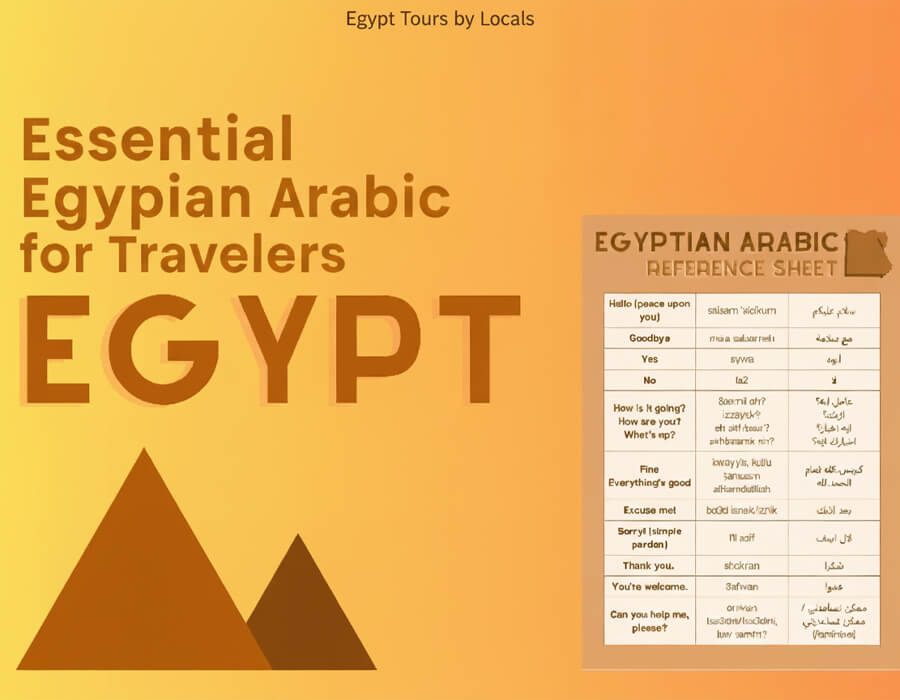
Pronunciation Guide
A few sounds in Egyptian Arabic that do not exist in English:
| Sound | How to Pronounce It | Example |
|---|---|---|
| ‘a / aa | Open ‘a’ as in ‘father’, held slightly longer | Sa’eed (happy) — the ‘a’ is wide and open |
| Kh (خ) | Like the ‘ch’ in Scottish ‘loch’ or German ‘Bach’ | Kheir (good) — a gentle throat rasp |
| Gh (غ) | A voiced version of Kh — like gargling gently | Ghali (expensive) — voiced back-of-throat sound |
| Q (ق) | In Egyptian dialect, often pronounced as a glottal stop (a tiny pause) rather than a hard Q | Ahlan — the ‘a’ is slightly stopped in some words |
| ‘ (ع — ain) | A voiced constriction from deep in the throat — no English equivalent | Arabee (Arabic) — the ‘a’ is slightly throaty |
| R | Slightly rolled, softer than Spanish R, not the English R | Ramadan — gently rolled R |
Do not be intimidated by these sounds. Egyptians are deeply appreciative of any attempt, however imperfect. A mispronounced ‘Shukran’ is infinitely better received than a silent nod.
Check our guides about Where to stay in Egypt
Core Survival Phrases
| English | Egyptian Arabic | Phonetic | When to Use |
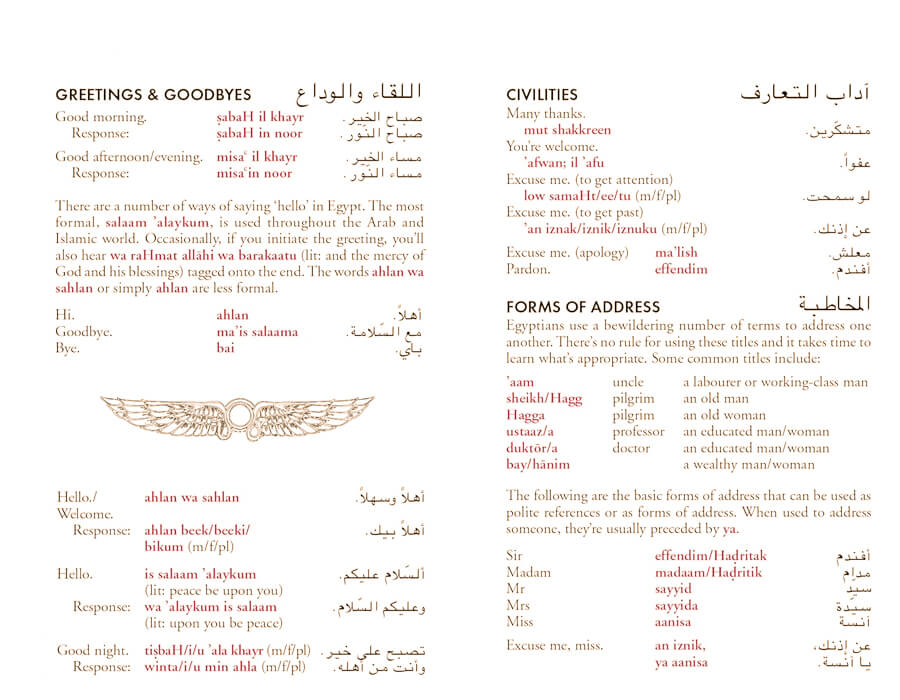
| Hello / Welcome | أهلاً وسهلاً | Ahlan wa sahlan | Universal greeting. Reply: ‘Ahlan beek’ (m) / ‘Ahlan beeki’ (f) |
| Hello (casual) | أهلاً | Ahlan | Casual — between equals |
| Good morning | صباح الخير | Sabah el-kheir | Morning greeting. Reply: ‘Sabah el-nour’ |
| Good evening | مساء الخير | Masa el-kheir | Evening greeting. Reply: ‘Masa el-nour’ |
| How are you? | عامل إيه؟ | Amel eh? | Casual ‘how are you?’ |
| I’m well, thank you | كويس، شكراً | Kwayyes, shukran | Standard reply |
| Thank you | شكراً | Shukran | Essential |
| Thank you very much | شكراً جزيلاً | Shukran gazilan | For genuine thanks — more emphatic |
| You’re welcome | العفو | El-afou | Reply to ‘shukran’ |
| Please | لو سمحت | Law samaht | Add to any request |
| Excuse me | لو سمحت / عن إذنك | Law samaht / An eznak | ‘Law samaht’ for requests; ‘An eznak’ to pass someone |
| Yes | أيوه | Aywa | Casual yes. ‘Na’am’ is more formal. |
| No | لا | La | Clear, not rude when said politely |
| No thank you | لا شكراً | La shukran | The most useful phrase in markets |
| I don’t understand | مش فاهم | Mish fahim (m) / Mish fahma (f) | Honest and gets you gentle help |
| Do you speak English? | بتتكلم إنجليزي؟ | Bettekellem engleezy? | Gets a helpful response almost everywhere in tourist Egypt |
| Sorry / Excuse me | آسف | Aasif (m) / Aasfa (f) | For minor bumps and errors |
At Restaurants & Food Stalls
| English | Egyptian Arabic | Phonetic | Notes |
| The menu, please | المنيو لو سمحت | El-menu, law samaht | |
| One portion, please | واحد لو سمحت | Wahid, law samaht | At street food stalls |
| Without spice / mild | بدون حار | Bedoun harr | Essential if chili-sensitive |
| The bill, please | الحساب لو سمحت | El-hisab, law samaht | |
| It’s delicious! | لذيذ جداً | Laziz giddan | Guaranteed to delight any cook |
| Water, please | مياه لو سمحت | Mayya, law samaht | |
| No sugar (coffee) | بدون سكر / سادة | Bedoun sukar / Sada | ‘Sada’ is the café term for unsweetened |
| A little sweet | مظبوط | Mazbouta | Medium sugar — for café coffee order |
| Very sweet | زيادة | Ziyada | For those who like it sweet |
Check Our Egypt Trip Cost 2026 full guide
Shopping & Negotiating
| English | Egyptian Arabic | Phonetic | Notes |
| How much? | بكام؟ | Bekam? | Essential in any market |
| That’s expensive | ده غالي | Da ghali | Opens negotiation honestly |
| Can you do better? | ممكن تنزل؟ | Momken tenzil? | Polite price reduction request |
| I’ll pay [X] pounds | هادي [X] جنيه | Haadi [X] geneih | State your price clearly |
| I’m just looking | بس بتفرج | Bass betfarrag | Discourages persistent sales |
| That’s my final price | ده آخر كلام | Da aakhir kalam | Closes negotiation — use when you mean it |
10 Phrases That Make Egyptians Light Up
These are not survival phrases. These are the expressions that, when a foreigner uses them correctly, produce a genuine reaction — a smile, a hand on heart, sometimes a short speech in reply. Use them.
1️⃣ Ramadan Kareem (رمضان كريم) — ‘Ramadan is generous’
Said to anyone observing Ramadan. The reply is ‘Allahu Akram’ (God is more generous). Saying this to your guide or hotel staff during Ramadan — even if you are not Muslim — is an act of genuine cultural respect that most Egyptians find deeply moving coming from a foreigner.
2️⃣ El-hamdulillah (الحمد لله) — ‘Praise be to God (I’m well)’
The standard reply to ‘how are you?’ Said by Muslims and non-Muslims alike in Egypt as a general expression of contentment. If someone asks how you are and you reply ‘El-hamdulillah’, you have stepped inside the culture rather than looking at it from outside.
3️⃣ Inshallah (إن شاء الله) — ‘God willing’
Possibly the most famous Arabic phrase in the world — and frequently misunderstood by tourists as evasiveness. In Egyptian usage, it genuinely expresses that the future is in God’s hands. Using it yourself — ‘Inshallah we will see you tomorrow’ — is warmly received.
4️⃣ Mabruk! (مبروك) — ‘Congratulations!’
Said at any good news — a new baby, a promotion, a good purchase, even a good meal. Egyptians use it freely and hearing it from a foreigner in a genuine moment surprises and delights people.
5️⃣ Tayeb (طيب) — ‘Okay / Good / Alright’
The most versatile word in Egyptian Arabic. It can mean ‘okay’, ‘I understand’, ‘sounds good’, or simply acknowledge what someone has said. Using it naturally in conversation immediately makes you sound more fluent than you are.
Check our Egypt Travel Tips for everything else you need to know before you go
6️⃣ Ya salam! (يا سلام) — An expression of wonder or admiration
Said when you see something beautiful, taste something wonderful, or hear good news. Standing in front of the temples at Luxor and saying ‘Ya salam!’ is understood immediately and is completely natural. Egyptians use it constantly.
7️⃣ Izzayak / Izzayik (إزيك / إزيكي) — ‘How are you?’ (m/f)
More casual and warmer than the formal ‘Keyf Halak’. Using the correct gender form (Izzayak for a man, Izzayik for a woman) shows you have paid attention. Egyptian men are sometimes delighted when foreign women use the feminine ending correctly.
8️⃣ Mesh mesaddaq! (مش مصدق) — ‘I can’t believe it!’
An expression of amazed disbelief — at the size of the Pyramids, the beauty of a sunset on the Nile, the quality of the food. Saying it to a local produces genuine pleasure.
9️⃣ Enta/Enti gameel/gameela (أنت جميل / أنتِ جميلة) — ‘You are beautiful’
Said with genuine warmth to a child, to an elder, or (carefully) as a compliment. Egyptian culture is comfortable with direct appreciation — this is not considered forward if said with genuine warmth.
🔟 Masr Umm el-Dunya (مصر أم الدنيا) — ‘Egypt is the mother of the world’
An old Egyptian saying of great cultural pride. Saying it to an Egyptian — and meaning it — produces one of the warmest reactions you will encounter in this country. This phrase says: I understand what this place means. It is received as a profound compliment.
Religious & Cultural Phrases to Know
| Phrase | Arabic | Phonetic | Meaning / Context |
| Peace be upon you | السلام عليكم | Assalamu alaykum | Standard Muslim greeting. Reply: ‘Wa alaykum assalam’ |
| In the name of God | بسم الله | Bismillah | Said before eating, beginning a journey, starting work |
| God willing | إن شاء الله | Inshallah | Future tense — any plan or hope |
| Praise be to God | الحمد لله | El-hamdulillah | Gratitude, contentment, reply to ‘how are you?’ |
| God is greatest | الله أكبر | Allahu Akbar | Call to prayer, expression of awe — don’t be startled |
| Ramadan is generous | رمضان كريم | Ramadan Kareem | Ramadan greeting — say to anyone fasting |
| Blessed Eid | عيد مبارك | Eid Mubarak | Said at Eid — end of Ramadan (Eid al-Fitr) and others |
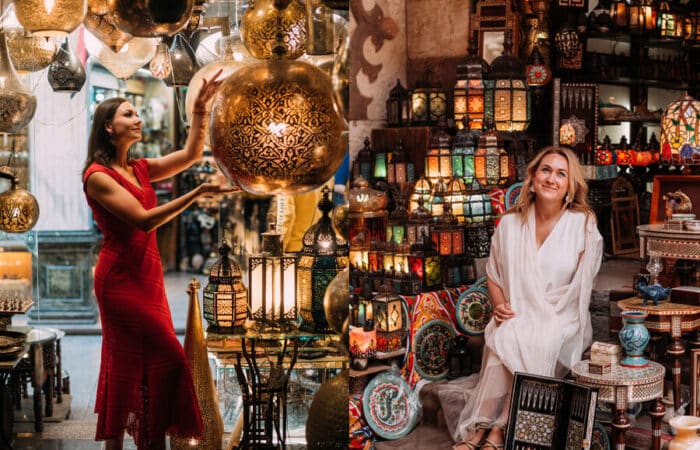
Bargaining Scripts for Khan el-Khalili
These are the exact exchange sequences your guide will use — and that you can attempt yourself in the market:
💬 Sample Negotiation Exchange
- Vendor: ‘For you, special price — 800 pounds.’
- You: ‘Bekam?’ (How much?) — even though they told you, saying this buys time
- You: ‘Da ghali!’ (That’s expensive!) — said with a smile, not aggression
- You: ‘Haadi 300 geneih’ (I’ll pay 300 pounds) — state your offer clearly
- Vendor: [counter-offers]
- You: ‘Momken tenzil shwaya?’ (Can you come down a little?)
- Final deal: ‘Tayeb, etfaddal.’ (Okay, here you go.) — hand over the money
Frequently Asked Questions
Is Egyptian Arabic the same as standard Arabic?
No. Egyptian Arabic (Masri) is the dialect spoken in Egypt and differs significantly from Modern Standard Arabic (MSA), which is the formal, written form of Arabic used across the Arab world. Egyptian Arabic also differs from Gulf Arabic, Levantine Arabic, and Moroccan Arabic. The good news: Egyptian Arabic is the most widely understood dialect across the Arab world, thanks to Egypt’s huge film and television industry — a phrase learned in Egyptian Arabic will be understood by Arabic speakers almost everywhere.
Do Egyptians speak English?
In tourist areas, at hotels, at major sites, and with tour guides: yes, English is widely spoken and the tourism industry is well-equipped for English-speaking visitors. In local markets, residential neighbourhoods, and non-tourist contexts: much less so. Learning even basic Arabic phrases dramatically improves your experience in these settings and is always warmly received.
How do you say ‘thank you’ in Egyptian Arabic?
‘Shukran’ (شكراً) is the standard ‘thank you’. ‘Shukran gazilan’ (شكراً جزيلاً) means ‘thank you very much’ and is used for genuine gratitude. ‘El-afou’ (العفو) is the reply to ‘shukran’ — equivalent to ‘you’re welcome’.
🔗 Related Guides
→ Dos and Don’ts in Egypt (wider cultural etiquette)
→ Ramadan in Egypt (Arabic greetings for Ramadan season)
→ Visiting Khan el-Khalili (where to use your bargaining phrases)
→ Popular Egyptian Food (how to order food in Arabic)